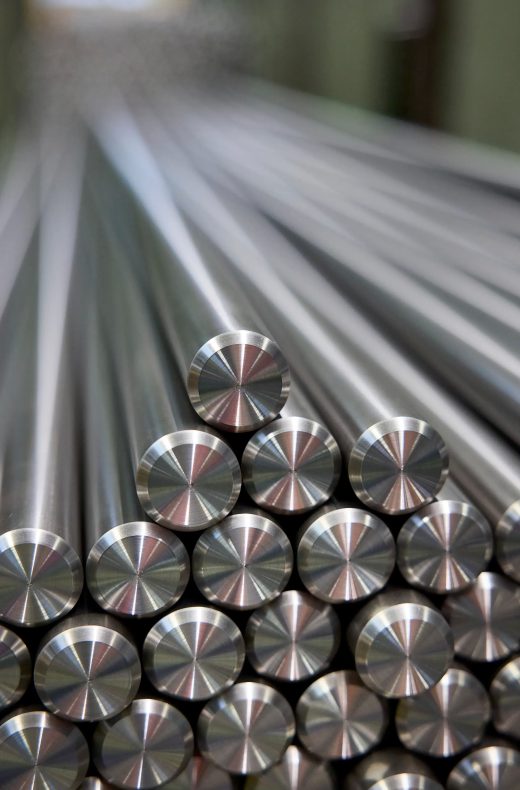
Quenched and tempered steels

Quenched and tempered steel is mainly used for dynamically stressed parts in mechanical engineering and toolmaking. It is characterized by higher strength, wear resistance and toughness, which are adjusted by suitable heat treatments. Quenched and tempered steels are either unalloyed or low-alloy steels.

Product Finder

Portfolio
Family
Material
Klassifikation
Material
Nummer
Brand
Product
Portfolio
Tool Steels
Material Classifictation
40CrMnMo7
Family
Plastic Moulding
Material Number
1.2311
Brand
Formadur 2316 /Superclean
Characteristics
Standard steel for Moulds
This is a Bar (Product) forged (Forming) quenched and tempered (Melting). You can get it in round (Shape) and processed (Finish).
Portfolio
Tool Steels
Material Classifictation
40CrMnMo7
Family
Plastic Moulding
Material Number
1.2311
Brand
Formadur 2316 /Superclean
Characteristics
Standard steel for Moulds
This is a Bar (Product) forged (Forming) quenched and tempered (Melting). You can get it in round (Shape) and processed (Finish).
Portfolio
Tool Steels
Material Classifictation
40CrMnMo7
Family
Plastic Moulding
Material Number
1.2311
Brand
Formadur 2316 /Superclean
Characteristics
Standard steel for Moulds
This is a Bar (Product) forged (Forming) quenched and tempered (Melting). You can get it in round (Shape) and processed (Finish).
Portfolio
Tool Steels
Material Classifictation
40CrMnMo7
Family
Plastic Moulding
Material Number
1.2311
Brand
Formadur 2316 /Superclean
Characteristics
Standard steel for Moulds
This is a Bar (Product) forged (Forming) quenched and tempered (Melting). You can get it in round (Shape) and processed (Finish).
Portfolio
Tool Steels
Material Classifictation
40CrMnMo7
Family
Plastic Moulding
Material Number
1.2311
Brand
Formadur 2316 /Superclean
Characteristics
Standard steel for Moulds
This is a Bar (Product) forged (Forming) quenched and tempered (Melting). You can get it in round (Shape) and processed (Finish).
Portfolio
Tool Steels
Material Classifictation
40CrMnMo7
Family
Plastic Moulding
Material Number
1.2311
Brand
Formadur 2316 /Superclean
Characteristics
Standard steel for Moulds
This is a Bar (Product) forged (Forming) quenched and tempered (Melting). You can get it in round (Shape) and processed (Finish).
  • 1
  • 2
  • 3
  • ...
  • 10

Properties at a glance

Quenched and tempered steels obtain their application properties through austenitizing, quenching and tempering. They cover a minimum tensile strength range of around 470 to 1250 N/mm² in the quenched and tempered condition. In addition to good tensile strength, they are also characterized by high yield strength and ductility. The properties in the final state should be as homogeneous as possible across the cross-section. Compared to quality steels, stainless steels not only have lower phosphorus and sulphur contents but also more uniform properties, for example after heat treatment.

edelbaustahl-staebe-lager

Hardness

After tempering, these steels achieve a high surface hardness, which makes them resistant to abrasion and wear.

Toughness

Despite the increased hardness, heat-treatable steels remain tough and can withstand impact and shock loads without breaking.

Ductility

Even after hardening, they retain a certain degree of ductility, which means that they can be deformed without failing.

Single-bar heat treatment

Single-bar heat treatment enables the highest quality and optimum utilization of the material potential through controlled adjustment of the microstructure and steel properties bar by bar. This leads to homogeneous mechanical properties across the entire bar and batch, meets the strict requirements of the automotive industry and exceeds the possibilities of coil tempering. Coil tempering harbors risks such as high scattering of steel properties and uneven microstructure formation, which can lead to failure and recalls in safety-relevant components. Single-bar tempering minimizes these risks and guarantees precise and consistent quality.

In addition, single-bar heat-treated steel meets the high requirements of the automotive industry, which are constantly increasing due to stricter DIN tolerances and standards. Steel bars are tempered on the XTP® system in accordance with CQI-9.

Precise solution

Precision adaptation for tightened tolerances in automotive and mechanical engineering

The solution to meet tightened tolerances in automotive and mechanical engineering is the inductive single-bar heat treatment. In this method, each bar undergoes heat treatment individually, ensuring uniform heating and consistent mechanical-technological steel properties. Swiss Steel Group employs modern technology, including laser monitoring for feed speed, to prevent technical defects and maintain consistently high steel quality. A database stores all relevant process parameters, and the in-house material laboratory optimizes technological settings for new or modified steels to achieve the required microstructures and mechanical properties.

auto-leichtbau-windkraftanlagen-umweltfreundliche-mobilitaet

Exceptional lengths with the highest steel quality

We use support tables of up to 13 meters in length to feed bars individually into the process. This enables bars with lengths of 2.80 meters up to 13 meters to be processed on the system. The dimensions of the coils for induction heating are adapted to the bar steel diameter, whereby three different dimension ranges from 15 to 80 millimetres can be selected. This adaptation achieves a high level of efficiency, as the non-contact heating of the steel becomes more effective. This increases the energy efficiency and precision of the tempering process, which in turn improves the quality of the steel.

Homogeneous tube coating

Innovation in quenching and tempering for optimum steel properties

We also offer uniform quenching and tempering of tubes, in which two tube lifters remove the quenching medium from the tubes to ensure homogeneous microstructures, properties and straightness of the steel tubes. The pressure in the ring nozzles, which quench the steel after tempering, is regulated by flow monitors. Tempering is then also carried out inductively. It is possible to quench the steel bars evenly and selectively in order to positively influence the steel properties and prevent hardening distortion. This process is low in decarburization and scaling and ensures uniform heat treatment.

Safe material processing

Some materials tend to form flakes at the end of the bar. In the worst case scenario, these can damage tools or test probes during further processing. To avoid this risk, we offer the option of automatically cutting off the start and end of each bar directly after the individual bar tempering process. Finally, the bars are collected in bundles to protect the material.

Moderne urbane landschaft zug flugzeug windkraft autobahn

Product portfolio for every application

Our steel is a driving force and cornerstone in a wide range of sectors and industries, driving them worldwide and playing a decisive role in solving current and future challenges.

Learn moreLink opens in a new tab.

Available in the following variants

Wire rod

  • untreated
  • thermomechanically treated

Steel bars

must meet high requirements in terms of straightness and freedom from surface or internal defects.

  • untreated
  • normalizing rolled
  • straightened / separated
  • crack-tested
  • ultrasonic-tested
  • demagnetized
  • verified against confusion
Edelbaustahl waelzlagerstahl staebe

Highest quality non-stop

In single bar heat treatment, the microstructure and steel properties are adjusted bar by bar in a controlled manner, thus fully exploiting the potential of the material. The result is the highest strength classes and a high-performance steel that is homogeneous in its mechanical properties across the entire bar and batch. The single-bar tempered steel therefore meets the high requirements of the automotive industry, which are constantly increasing due to stricter DIN tolerances and standards.

Newscenter

Sustainability  |  09/01/2026

Swiss Steel Group once again secures top “A” score in CDP rating

Swiss Steel Group has been awarded the highest rating, “A,” in CDP’s annual sustainability assessment for climate change for the second consecutive year. This distinction, conferred by the internationally recognized non-profit organization CDP, underscores the Group’s continued commitment to climate action and sustainable business practices. This achievement reinforces Swiss Steel Group’s position as a leader in corporate transparency and action on climate change, standing out from nearly 22,100 companies assessed.

Read more

Products  |  15/12/2025

Swiss Steel Group publishes new white paper on efficiency in machining

What makes steel truly machinable? Cutting speed, tool life, and process stability determine the cost-effectiveness of machining. Our new white paper "Machinability" shows how machinability-optimized special steels can measurably improve productivity, quality, and sustainability.

Read more

Products  |  22/10/2025

Swiss Steel Group launches "Machinability – Keep the World Turning" campaign

Materials expertise for precision, process stability and energy efficiency in machining

With its "Machinability – Keep the World Turning" campaign, Swiss Steel Group is launching an international initiative to promote competence and innovation in machining. The campaign celebrates the partnership between Swiss Steel Group and the machinists who turn steel into progress – highlighting how material expertise, precision and collaboration keep the world moving. The campaign will kick off on 21 and 22 October 2025 at the Ugitech site in Ugine (France) with presentations and discussions on current developments in the machining of stainless steels and engineering steels.

Read more

Contact us
Results are loading